
Lead Screw Backlash: What It Is and How Anti-Backlash Nuts Fix It

Backlash is the small gap between the thread of a lead screw and the thread of its nut. Every standard nut has some, because a nut that fitted with no clearance at all would not turn. The gap shows up in two ways. When the screw reverses, it turns a little before the nut starts to move back. And when the screw is stopped, a push on the nut can slide it by the size of the gap. This guide shows how big the gap should be on a new screw and nut, how to measure it, and when an anti-backlash nut is the right fix.
 The same Apex Tr 12×3 screw with a standard nut (top) and an anti-backlash nut (bottom), each turned by a stepper motor. The thread clearance is drawn 4× larger than real so you can see it.
What is backlash in a lead screw?
Look inside a nut on a trapezoidal screw and the nut thread sits in the groove of the screw thread with a little room on each side. When the screw turns and drives the nut, one face of the screw thread (one flank) pushes on one flank of the nut thread. The gap is all on the other side.
Now reverse the screw. The flank that was pushing moves away, and the other flank has not reached the nut yet. For a few degrees the screw turns and the nut does not move at all. Only when the screw has crossed the gap does it touch the other flank and pull the nut back. That turn is lost on every reversal. This is called lost motion, and the gap that causes it is the backlash.
The same gap shows up a second way. With the screw stopped, anything that pushes the nut along the axis can slide it across the gap without the screw turning. That can be a cutting force, gravity on a vertical axis, vibration, or the carriage's own momentum when it stops. On a machine this is often the part that hurts: a milling table that jumps forward when the cutter grabs, or a slide that settles after it stops.
So backlash is not about the motor or the screw running out of torque. During the lost turn, nothing is touching the nut in the direction the screw is now turning, so nothing can move it.
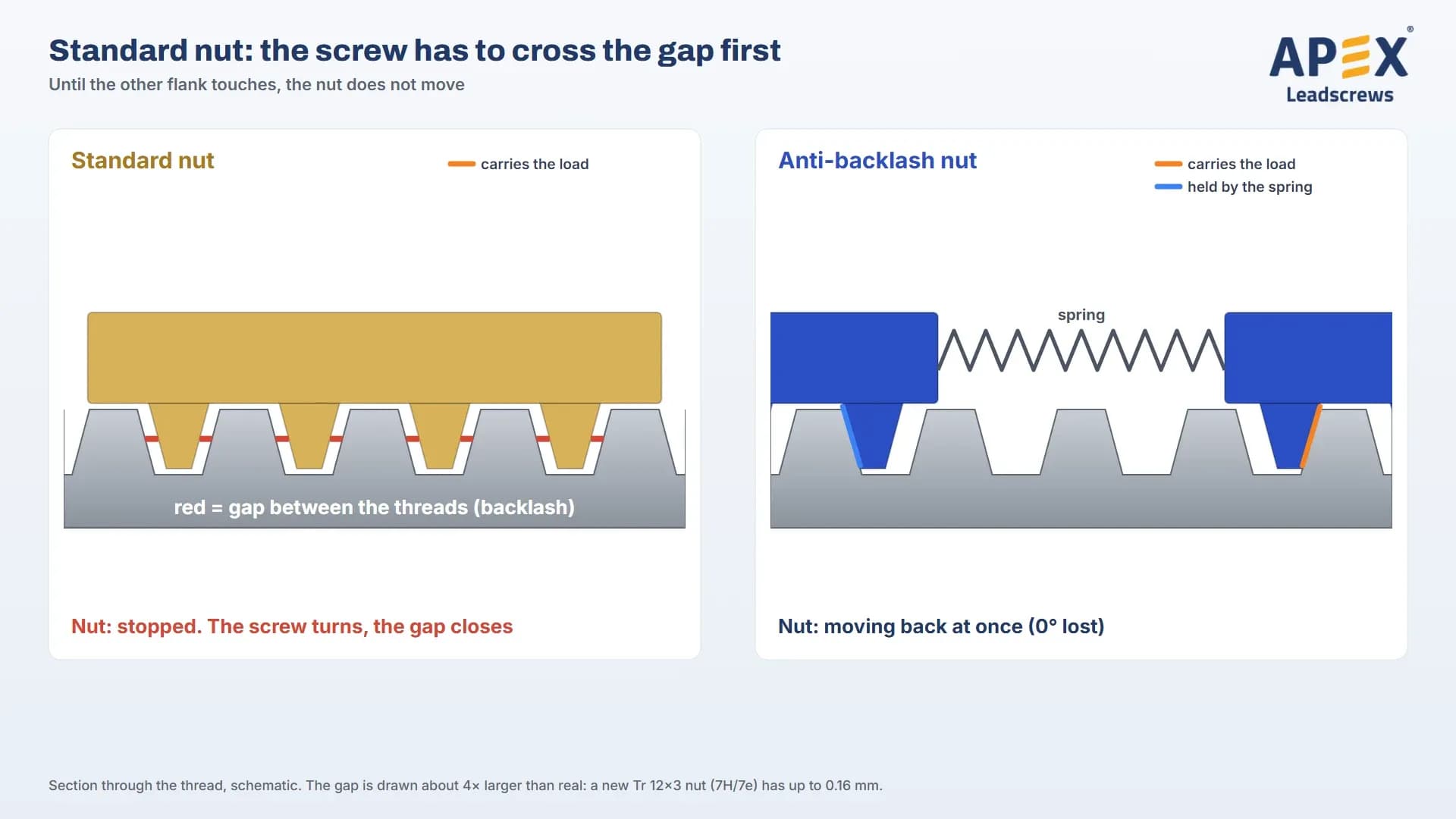 Section view, schematic. Left: the standard nut, with the gap (red) the screw has to cross. Right: an anti-backlash nut, two halves held apart by a spring, one on each flank.
Where backlash comes from
- Thread clearance. A screw and nut are made to tolerances, and the standard tolerances leave a clearance between the flanks on purpose. Without it the nut would bind on the smallest error in pitch, straightness or temperature.
- Wear. A nut wears on its flanks, so the gap grows with use. The middle of the travel, where the axis works most, usually wears first.
- The rest of the drive. Not everything that looks like backlash is in the thread. End play in the screw's support bearings, a loose nut housing, a coupling that winds up, or a frame that flexes all add lost motion. A nut swap will not fix those.
How much backlash is normal?
For metric trapezoidal threads the tolerances are set by ISO 2903. The common class for a general-purpose screw and nut is 7H for the nut and 7e for the screw. From the tolerance tables in the standard you can work out the gap on a new pair. The flank clearance is the difference between the nut and screw pitch diameters, multiplied by tan 15° for the 30° thread:
| Thread (new, 7H/7e) | Axial backlash | Screw turn lost on reversal |
|---|---|---|
| Tr 12×3 (lead 3 mm) | 0.023 to 0.16 mm | 2.7° to 20° |
| Tr 20×4 (lead 4 mm) | 0.025 to 0.19 mm | 2.3° to 17° |
These figures are for the thread alone, on a new screw and nut. Pitch error along the screw and wear both add to them, and a nut that has done a few years of work can have several times its new play.
To turn a backlash figure into the screw turn you lose, divide by the lead:
where is the backlash in mm and is the lead in mm. On a Tr 12×3 screw driven by a 1.8° stepper motor, 0.16 mm of backlash is 19.6° of screw turn, or about 11 full motor steps that move nothing every time the axis reverses. On a fast multi-start screw the same backlash is a smaller angle, because each degree of turn moves the nut further.
Practical tip: If your machine always approaches a position from the same direction, backlash never shows in that position. Many controllers can be set to finish every move from one side for exactly this reason.
How to measure lead screw backlash with a dial indicator
You need a dial indicator that reads 0.01 mm, a magnetic base, and a way to turn the screw in small steps (a handwheel, or jogging the motor).
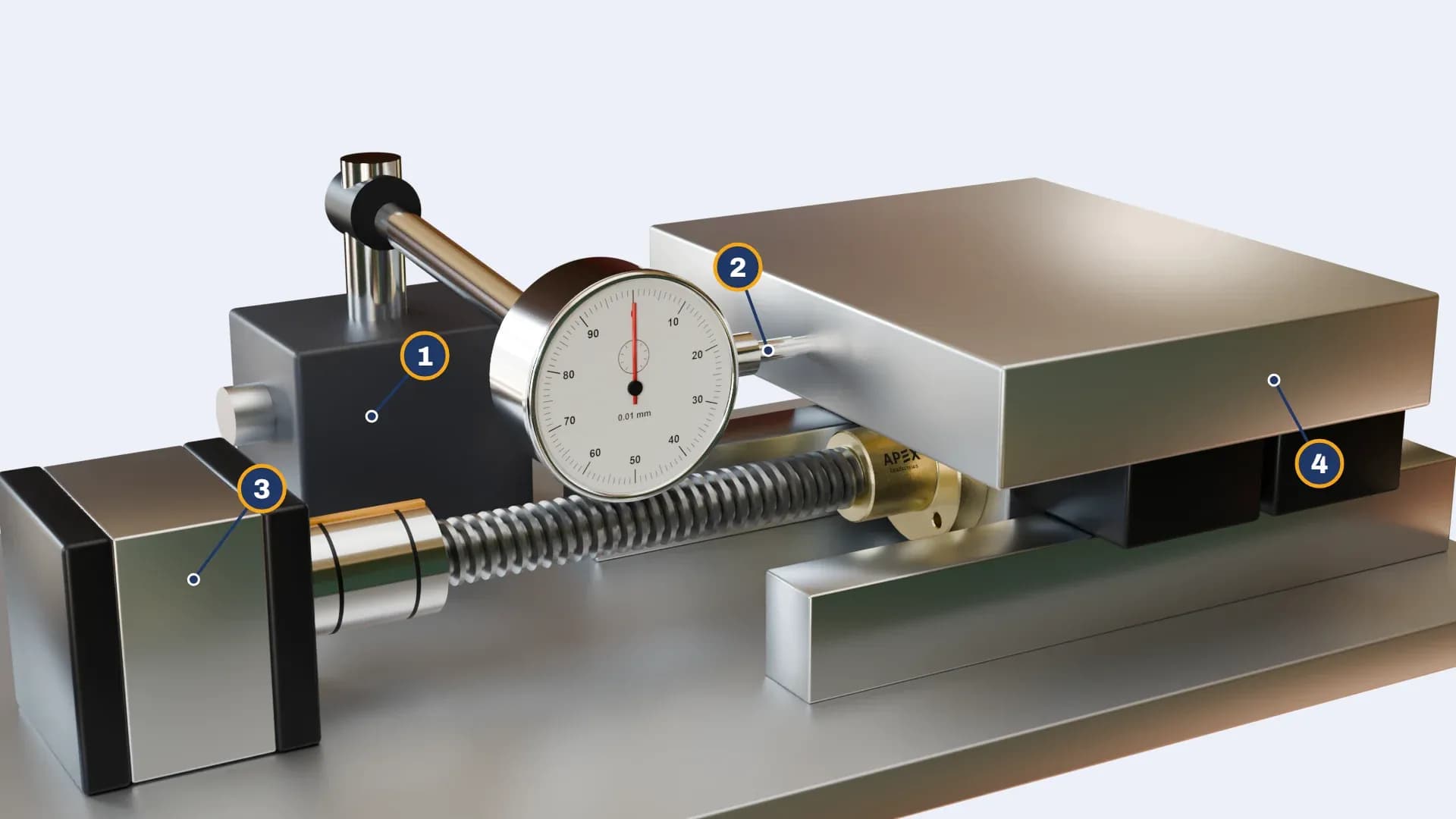 1: magnetic base on the machine frame. 2: indicator plunger on the end of the carriage, along the screw axis. 3: the motor (or a handwheel) turns the screw. 4: the carriage on its linear guides, with the nut bolted underneath.
- Fix the magnetic base to the machine frame, not to anything that moves. Set the indicator plunger against the carriage (or the nut flange), along the screw axis.
- Drive the axis a few millimetres in one direction and stop. This puts the nut firmly on one flank.
- Zero the indicator.
Test 1, reversal (lost motion). Command a small move back, for example 0.50 mm, and read the dial. If it shows 0.38 mm, the axis lost 0.12 mm to backlash. Without a controller, turn the screw back in small steps instead and count them until the needle starts to move: steps ÷ steps per turn × lead gives the same figure in millimetres.
Test 2, push and pull (play). Switch the motor off or lock the screw so it cannot turn. Push the carriage firmly one way, then pull it the other. The total swing of the needle is the play in the drive.
Do both tests at each end and in the middle of the travel, and compare:
| What you find | Likely cause |
|---|---|
| Close to the table above, the same everywhere | Normal thread clearance |
| Well above the table, the same everywhere | Not the thread: support bearing end play, a loose coupling or nut housing |
| More in the middle than at the ends | Worn nut and screw where the axis works most |
| Test 2 much larger than test 1 | Something moves under load: check the nut mounting and the bearings |
A 0.01 mm dial indicator is enough for a lead screw, where backlash runs from a few hundredths to a few tenths of a millimetre. Ball screws, with backlash of a few microns, need a 0.001 mm indicator.
When backlash matters, and when it does not
Backlash only causes trouble when the load on the nut changes direction.
- It matters on axes that move both ways and must land in the same place from either side: machine tool slides, pick-and-place heads, measuring and inspection stages, dosing pumps.
- It matters when an outside force can pull the nut ahead of the screw: climb milling, a spring or a cylinder pushing on the carriage, sudden stops of a heavy slide.
- It matters less when the load always pushes the same way. On a vertical axis, the weight of the carriage keeps the nut on the same flank in both directions, as long as the axis does not accelerate downward faster than gravity. A lifting table or a press axis often runs well with a standard nut.
- It does not matter for a feed that only ever moves one way during the work and returns empty, if the start of each stroke is approached from the same side.
Four ways to deal with backlash
- Live with it. Approach every position from the same direction, or keep the load on one flank. This costs nothing and is often enough.
- Compensate in software. Most CNC and motion controllers can add a set amount of travel every time an axis reverses. This works for lost motion on reversal. It does not stop a load from pushing the nut across the gap with the screw stopped, and the compensation goes wrong as the nut wears unless you re-measure it.
- Fit a closer nut. A nut made to a tighter fit on your screw reduces the gap, at the cost of a little more friction and less tolerance for dirt, misalignment and heat.
- Use an anti-backlash nut. This removes the gap mechanically, keeps removing it as the nut wears, and also stops the nut sliding under a reversing load. It is the fix when positioning matters in both directions.
How an anti-backlash nut works
An anti-backlash nut keeps the screw thread in contact on both flanks all the time, so there is no gap to cross. Apex anti-backlash lead nuts come in two types:
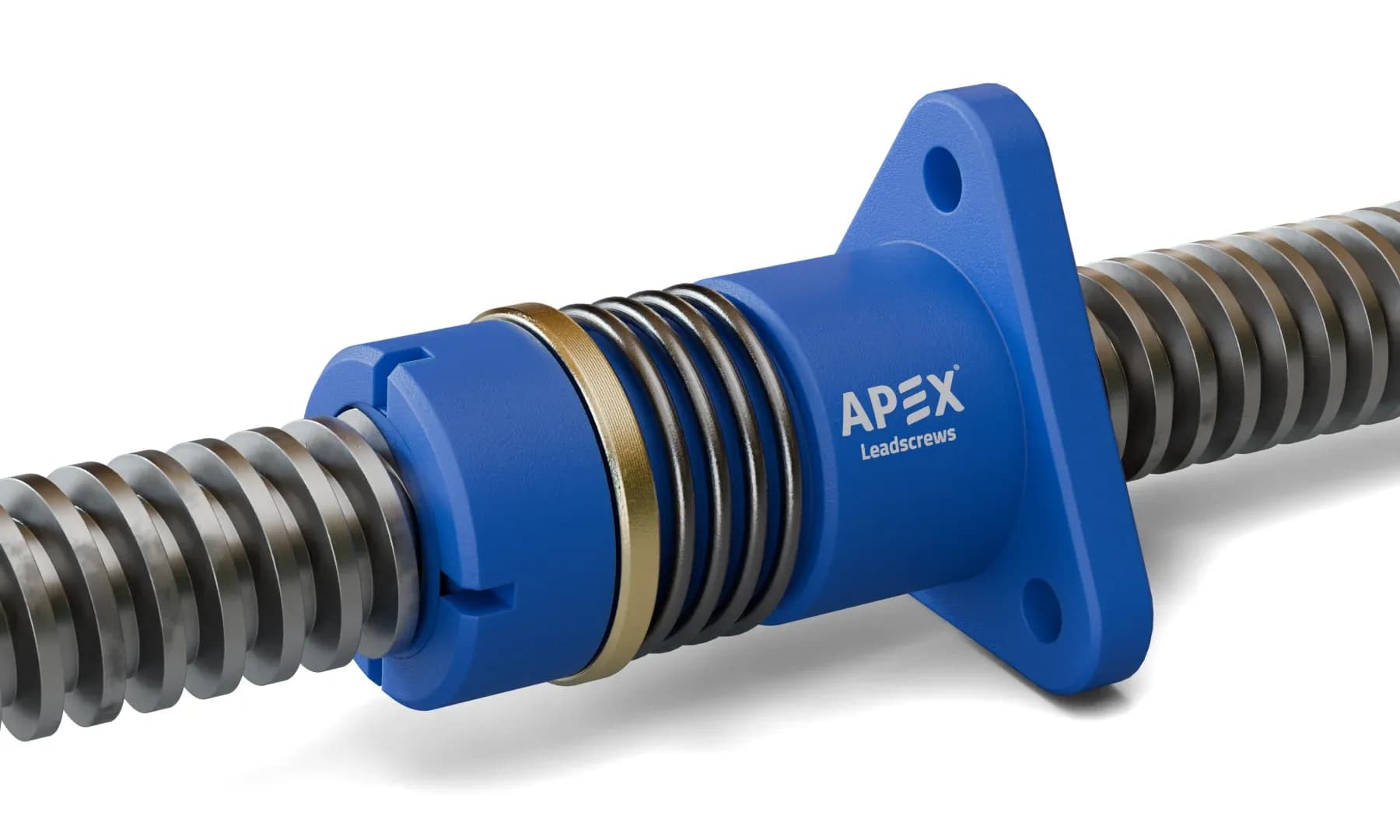
- Axial loaded. The nut is made in two halves on the same screw. A spring pushes the halves apart along the axis, so one half rests on one flank and the other half rests on the opposite flank. This is the nut in the animation above.
- Radial loaded. The nut is slotted along its length, and a ring or spring squeezes the slotted part inward onto the screw, so the thread is pressed into both flanks from the side.
Both types also take up wear. As the threads wear, the spring keeps pushing, so the nut keeps its zero-play fit for much longer than a standard nut keeps its new clearance.
Things to check before you fit one:
- Drag torque. Pressing the thread onto both flanks adds friction. The motor needs some extra torque to turn the screw, and the nut runs a little warmer. Allow for it when you size the motor, especially on small steppers.
- Load against the spring. In an axial nut, one half is fixed to your carriage and the other floats on the spring. A load that pushes towards the fixed half is carried solidly. A load in the other direction is carried through the spring, and if it is larger than the spring force the spring gives and some play comes back. Mount the nut so the larger working load is on the fixed half, and tell us the load so we can size the spring.
- Speed and duty. Preloaded threads wear faster than free ones. On an axis that runs long distances at high speed and only needs accuracy at the end of the move, positioning from one side may be the better choice.
Practical tip: Measure the backlash before you change anything. If the dial indicator shows far more than the table above, check the support bearings, the coupling and the nut housing first. An anti-backlash nut cannot remove play that is not in the thread.
Frequently asked questions
What is backlash in a lead screw?
The axial clearance between the screw thread and the nut thread. It shows as lost motion when the screw reverses, and as play when an outside force pushes the nut with the screw stopped.
How much backlash is normal for a lead screw?
For a new metric trapezoidal screw and nut in the common 7H/7e class, up to about 0.16 mm on Tr 12×3 and 0.19 mm on Tr 20×4, from the ISO 2903 tolerances. Wear adds to it over time.
Can software compensate for backlash?
It can correct the lost motion when an axis reverses. It cannot stop an outside force from moving the nut across the gap while the screw is stopped, and it needs re-measuring as the nut wears.
Do I need an anti-backlash nut on a vertical axis?
Often not. If the weight of the carriage always keeps the nut on the same flank, the gap never opens. You need one if the axis accelerates downward hard, or if process forces can lift the carriage.
Does an anti-backlash nut need a bigger motor?
It needs a little more torque, because the preload adds friction on both flanks. Allow for this when you size the motor, and give us your load so the preload can match it.
Getting the right nut for your axis
Send us the screw size, the load and how much play you measure, and we will suggest a nut: a standard flange nut, a closer-fitted one, or an Apex anti-backlash nut. To choose the screw itself, see how to select the right lead screw and ACME vs trapezoidal lead screws.
Related Videos
Fighting lost motion on an axis?
Send us the screw size, the load and the play you measure. We will suggest a standard, closer-fitted or anti-backlash nut and quote it.
Related Articles
How to Select the Right Lead Screw
Eight steps to choosing a lead screw: load and speed, diameter, material, thread profile, pitch and lead, nut and backlash, mounting and thread process.
ACME vs Trapezoidal Lead Screws: Differences and Selection
ACME is a 29° inch thread, trapezoidal a 30° metric one. How to tell them apart with a vernier, why near-miss sizes jam a nut, and what to specify.