ACME vs Trapezoidal Lead Screws: Differences and Selection

An ACME lead screw has a 29° thread measured in inches. A trapezoidal lead screw has a 30° thread measured in millimetres. The two look the same and work almost the same, but a nut made for one will not run properly on the other. This guide shows how to tell them apart with a micrometer and a vernier. It also explains why near-miss sizes jam or wear a nut, and what to write on a drawing so you get the screw you need.
ACME and trapezoidal side by side
| ACME | Trapezoidal (Tr) | |
|---|---|---|
| Included thread angle | 29° | 30° |
| Units | Inch: diameter in inches, pitch as threads per inch (TPI) | Metric: diameter and pitch in mm |
| Example designation | 1"-5 ACME (1 inch, 5 threads per inch) | Tr 25×5 (25 mm, 5 mm pitch) |
| Standard | ASME B1.5 (general purpose and centralizing); ASME B1.8 (stub ACME) | DIN 103; ISO 2901 to 2904 |
| Basic thread height | Half the pitch (stub ACME: 0.3 × pitch) | Half the pitch, plus a small crest clearance |
| Fit classes | General purpose 2G, 3G, 4G; centralizing 2C and tighter | Tolerance classes such as 7e for the screw (ISO 2903) |
| Where you meet it | Machines designed in North America | Machines designed in India, Europe and most metric markets |
Both are trapezoid-shaped power threads with flat crests and roots. What matters when you buy one (diameter, pitch, tolerances) is defined in a different unit system by a different standard. That is the real difference, more than the one degree of angle.
Where the two forms come from
The ACME thread was introduced in the United States in 1894 to replace the square thread on power screws. A square thread is hard to cut and its wear cannot be taken up. A sloped flank is easier to cut and lets an adjustable nut close up as it wears. The metric trapezoidal thread is the same idea with a 30° angle and millimetre sizes. It was standardised in Germany as DIN 103 and later by ISO. ISO 2901 covers the profiles, ISO 2902 the diameter and pitch combinations, ISO 2903 the tolerances and ISO 2904 the basic dimensions.
The name ACME is not an abbreviation. It comes from the Acme Machinery Company of Cleveland, Ohio, where the name was proposed.
Why the names get mixed up
In India, and in many hobby and 3D printer listings worldwide, "ACME" is often used for any lead screw with a trapezoid-shaped thread. A "T8 ACME screw" or an "8 mm metric ACME rod" is in fact a metric trapezoidal screw. There is no metric ACME standard: if the size is in millimetres, the thread is trapezoidal, whatever the label says.
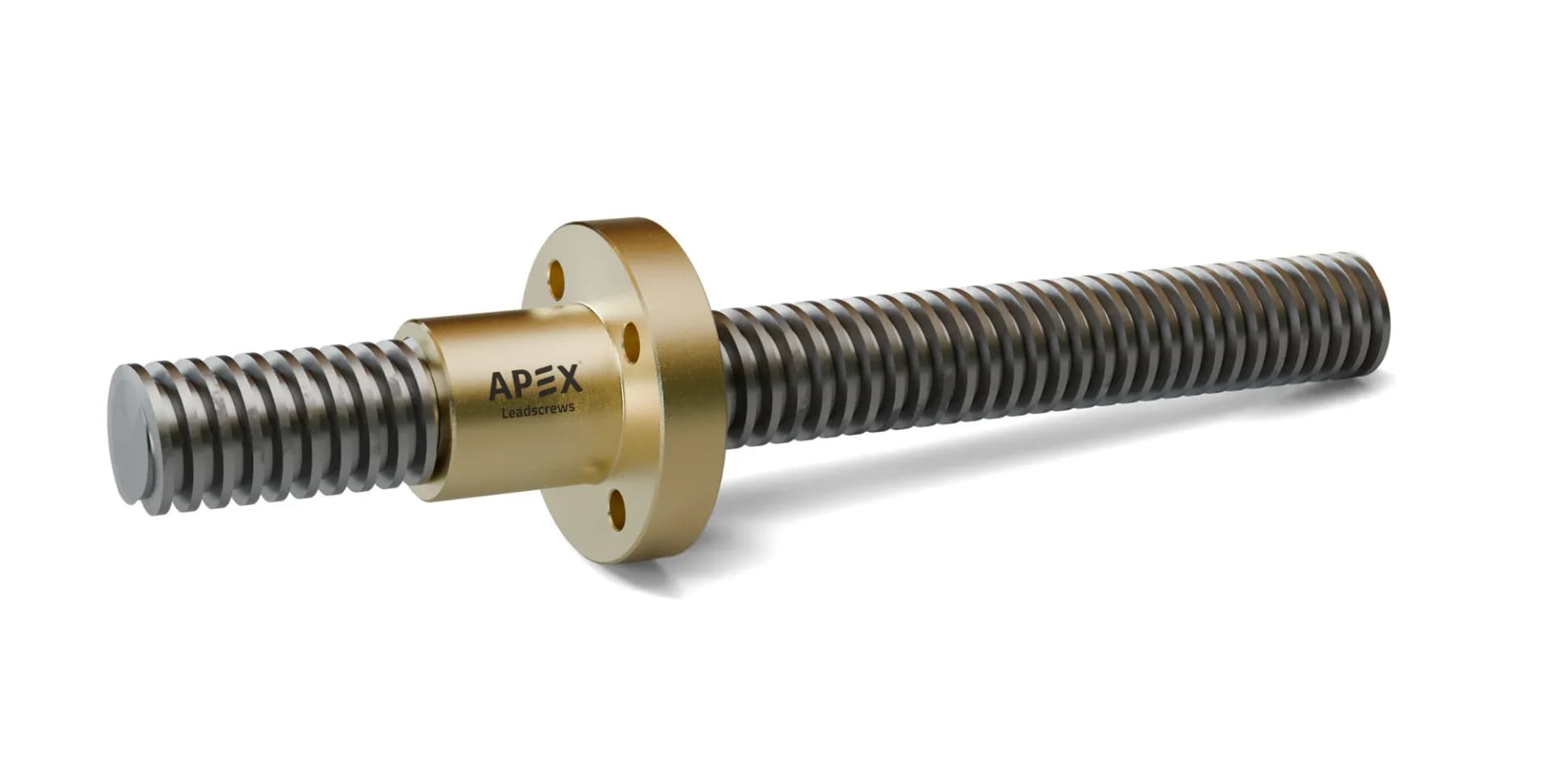
Catalogue codes add a second layer. Apex lists its screws by diameter, lead and pitch: D20x4P4 is a 20 mm screw with a 4 mm lead and a 4 mm pitch, which is a single-start Tr 20×4. D16x16P2 has a 16 mm lead and a 2 mm pitch, so it has 16 ÷ 2 = 8 starts. Apex makes its single-start and multi-start leadscrews in trapezoidal and ACME forms, rolled or ground, in EN8 and stainless steel.
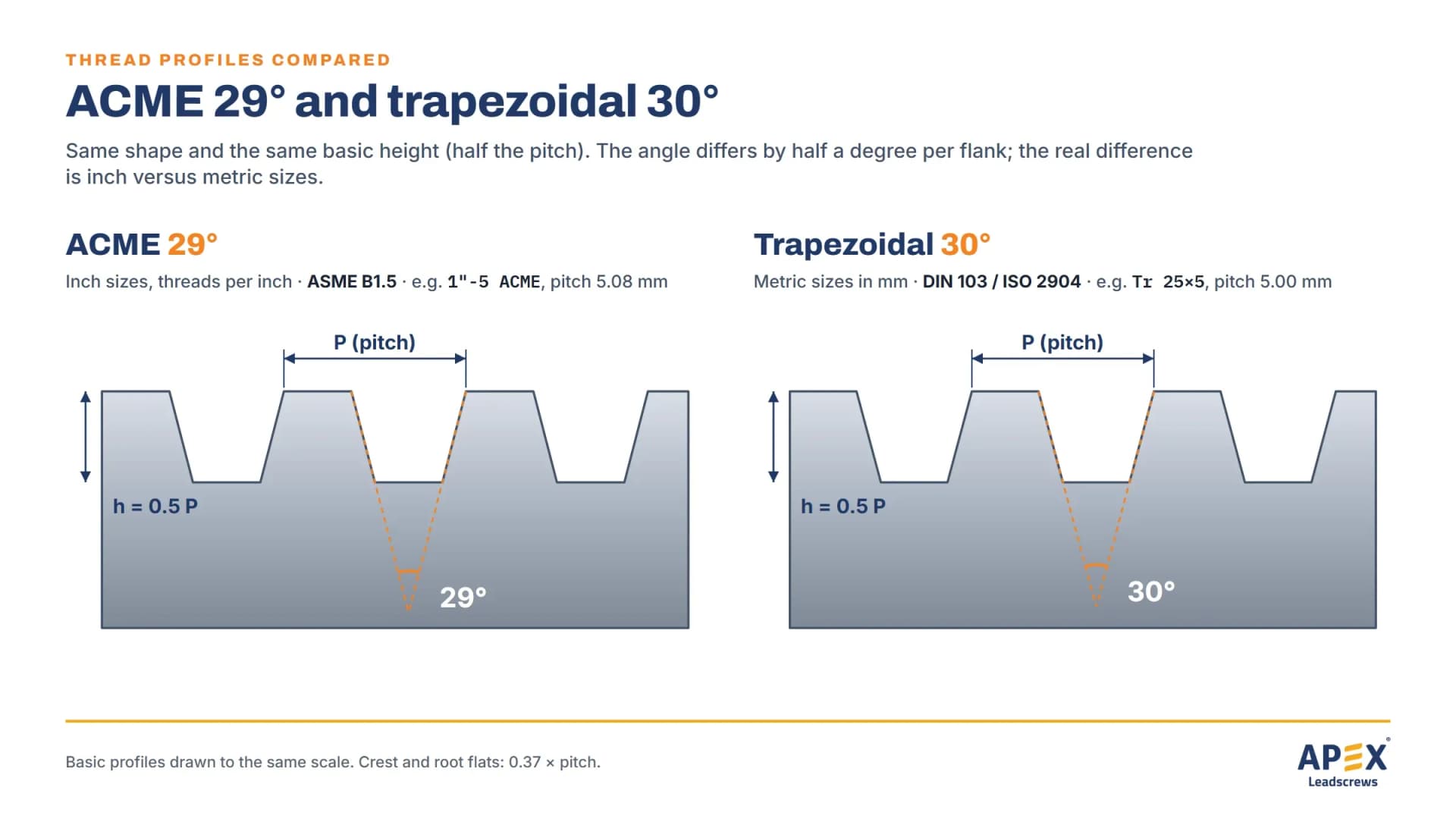 ACME (29°) and trapezoidal (30°) profiles: the angle difference is half a degree per flank
Practical tip: When a customer or a drawing says "ACME", ask one question before anything else: is the size in inches or in millimetres? That answer settles the thread form.
Near-miss sizes: why the wrong nut jams or wears
Several common inch ACME sizes sit within a millimetre of metric trapezoidal sizes. The diameters differ by less than a millimetre and the pitches by a few hundredths. The pitch error is the dangerous part, because it adds up along the nut: every thread of the nut sits a little further out of step with the screw than the one before.
| Inch ACME | Diameter / pitch (mm) | Nearest Apex metric screw | Diameter / pitch (mm) | Pitch error added up over 10 threads |
|---|---|---|---|---|
| 1/2"-10 | 12.70 / 2.540 | D12x2.5P2.5 | 12 / 2.5 | 0.40 mm |
| 5/8"-8 | 15.88 / 3.175 | D16x3P3 | 16 / 3 | 1.75 mm |
| 3/4"-6 | 19.05 / 4.233 | D20x4P4 | 20 / 4 | 2.33 mm |
| 1"-5 | 25.40 / 5.080 | D25x5P5 | 25 / 5 | 0.80 mm |
Take the closest pair, a 1"-5 ACME screw and a Tr 25×5 nut. The pitches are 5.08 mm and 5.00 mm, a difference of 0.08 mm per thread. Over a nut 50 mm long (10 threads), the last thread of the nut is 0.8 mm out of step with the screw, about a sixth of the pitch. Instead of sharing the load over all ten threads, the nut either starts by hand and jams after a few turns, or carries the load on the few threads at one end. Those threads then wear quickly. Two pairs in the table are worse: on a 5/8"-8 screw, a 16×3 metric nut is 1.75 mm out of step after 10 threads.
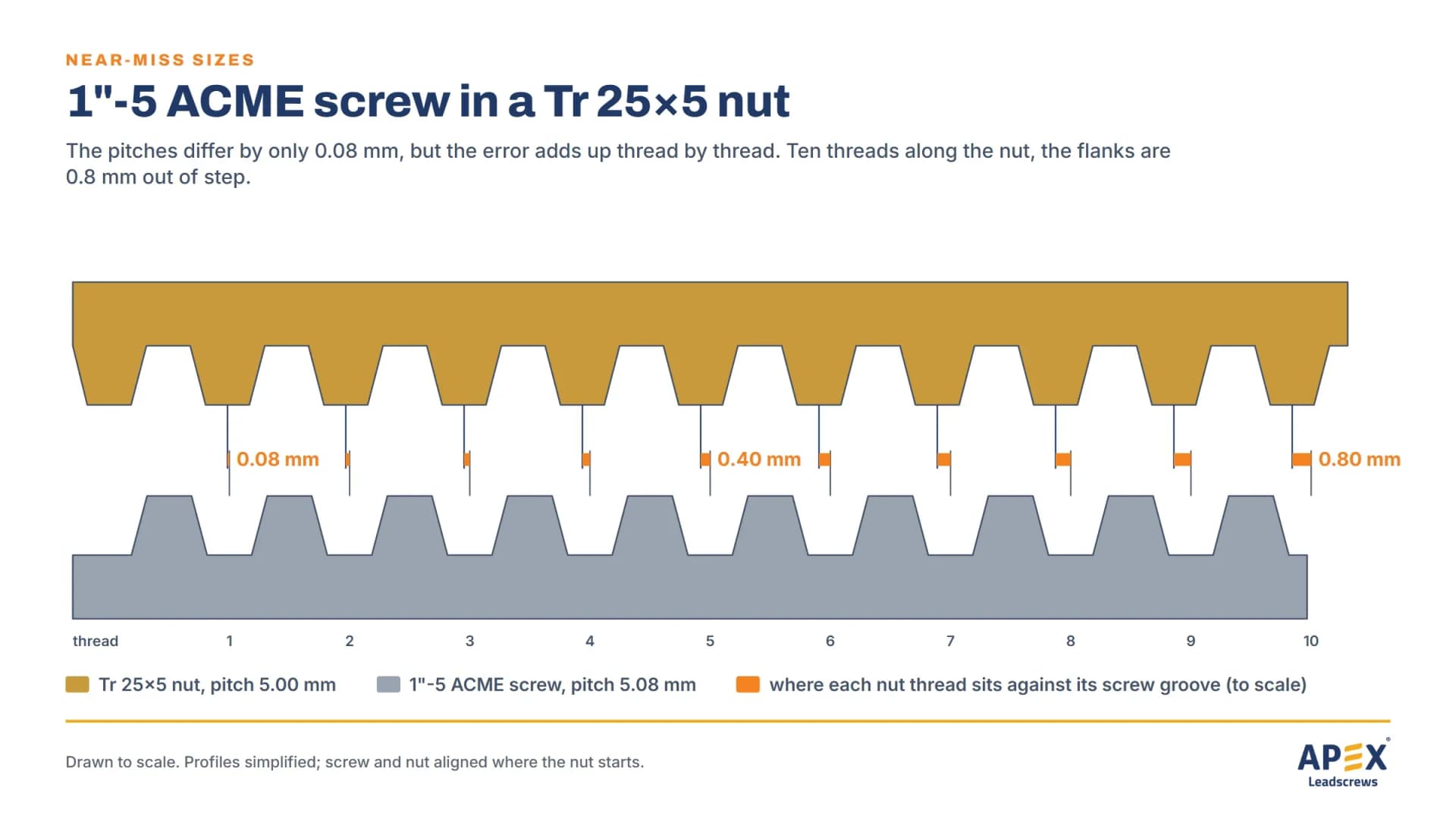 The pitch error grows thread by thread: 0.08 mm at the first thread, 0.8 mm at the tenth
This is why "nearly the same size" is not good enough for a lead screw and nut. Order both from the same thread system, ideally as a matched pair.
How to identify an unknown lead screw
Do not try to judge the angle: half a degree per flank is too small to see on a used screw. Diameter and pitch decide it.
- Measure the major diameter with a micrometer on an unworn part of the screw. Inch sizes land close to 12.70, 15.88, 19.05, 22.23 or 25.40 mm; metric sizes close to whole millimetres (12, 16, 20, 25 mm). Expect the reading to be a little under nominal.
- Measure ten pitches, not one. Put the vernier jaws on the crest of one thread and the crest of the eleventh, along the same side of the screw. A 1"-5 ACME screw measures 50.80 mm; a Tr 25×5 measures 50.00 mm. Over one pitch the difference is 0.08 mm and easy to miss; over ten it is 0.8 mm and plain to see.
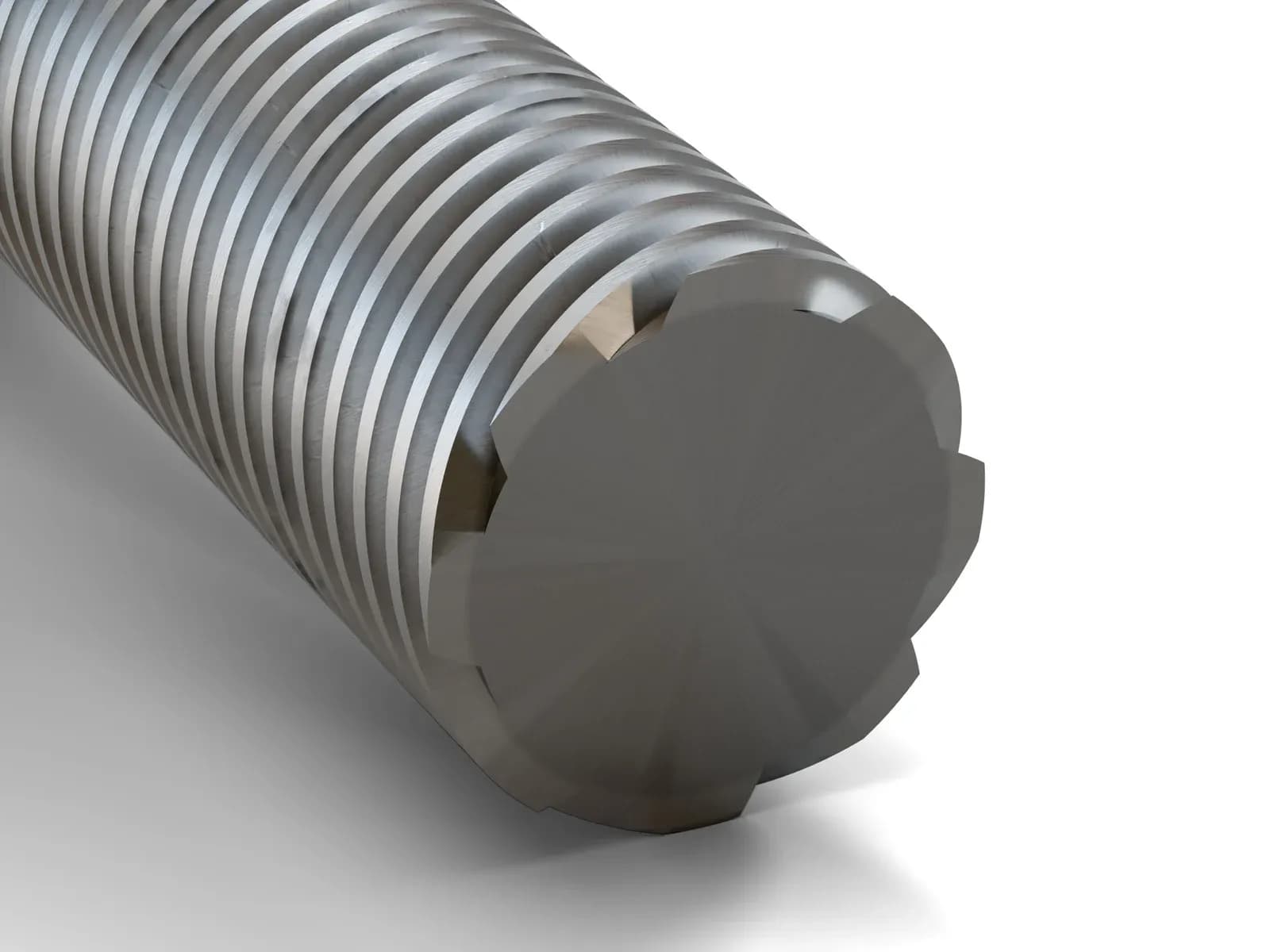
- Count the starts on the end face. Two, four or eight thread ends mean a multi-start screw: the lead is the pitch times the number of starts.
- Check the hand. Hold the screw vertically: if the visible threads rise to the right, it is right-hand. Left-hand screws are made on request.
- Look at where the machine was designed. A machine from a North American builder is likely to be ACME; one from an Indian or European builder is likely to be metric trapezoidal. Treat this as a hint and let the measurements decide.
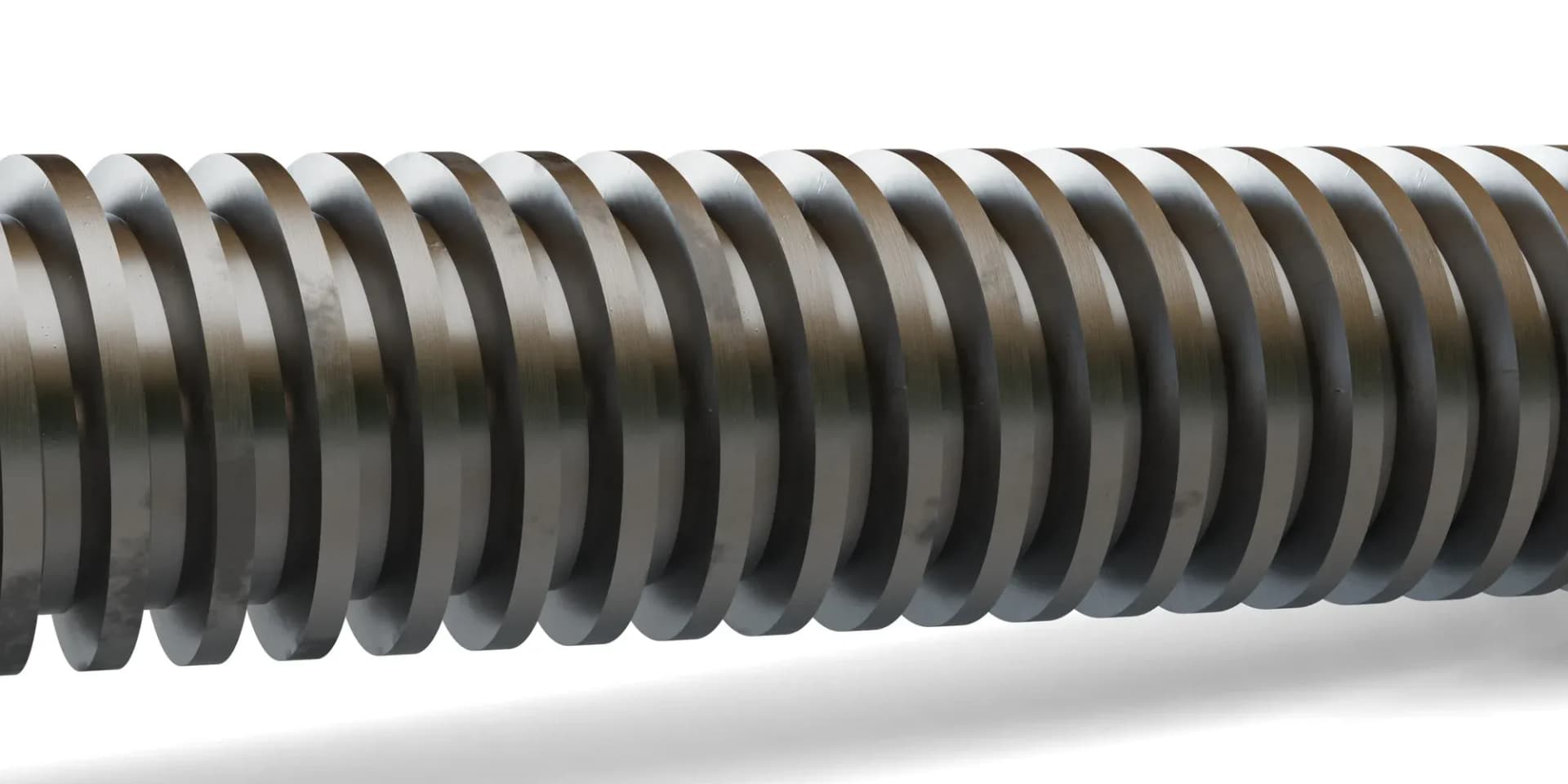
If the screw is worn, take the measurements on the end that the nut does not reach, or send us the screw and the nut together.
29° or 30°: what it changes in performance
Less than the name suggests. Efficiency, load capacity and wear depend on the lead angle, the nut material, lubrication and the surface finish of the screw far more than on half a degree of flank. Published figures for trapezoidal screws put mechanical efficiency at roughly 20% to 40%, depending on lead angle, friction and nut material.
The lead angle is easy to work out from catalogue data:
where is the lead angle, the lead and the pitch diameter, both in mm. For the Apex D20x4P4 (lead 4 mm, pitch diameter 18 mm), is about 4°. For the eight-start D16x16P2 (lead 16 mm, pitch diameter 15 mm), it is about 19°.
That difference matters far more than ACME versus trapezoidal. A single-start screw with a lead angle of about 5° or less is generally self-locking, so it holds a vertical load when the motor stops. A high-lead multi-start screw like the D16x16P2 moves the nut 16 mm per turn and is not self-locking: on a vertical axis it needs a brake or a motor that holds position.
One thread-related choice does affect behaviour: the fit class. ACME centralizing classes (2C and tighter) have less clearance at the major diameter, so the nut does not wedge on its flanks if a radial load pushes it sideways. Even so, a lead screw nut is not meant to carry a side load from a belt or pulley; support those loads with guides and bearings. For backlash, the bigger lever is the nut design: see our anti-backlash nuts.
What to write on your drawing or RFQ
Most wrong deliveries start with an incomplete thread call-out. Give the supplier all of this:
- Thread form and standard: "Tr 20×4 (DIN 103 / ISO 2904)" or "3/4"-6 ACME 2G (ASME B1.5)". "ACME screw 20 mm" is not enough.
- Starts and lead for multi-start screws: for example "Tr 16×16 (P2)", which is 16 mm lead, 2 mm pitch, 8 starts.
- Hand: right-hand unless stated; write "LH" for left-hand.
- Tolerance or fit class if your application needs it (for example 7e for a trapezoidal screw, 2G or 2C for ACME).
- Length and end machining: overall length, journal diameters, keyways, threads for the bearing nut. A dimensioned sketch is enough.
- Material: for example EN8 or stainless steel for the screw.
- Process if accuracy matters: rolled, cut or ground. In the Apex range, ground screws hold run-out to 0.03 mm against up to 0.1 mm for rolled or cut screws, at a higher cost.
- Nut: type (flange, block, anti-backlash), material and quantity, ordered with the screw. See our leadnuts.
For the load, speed and buckling side of the choice, follow our guide on how to select the right lead screw.
Summary
- ACME: 29°, inch sizes, ASME B1.5. Trapezoidal: 30°, metric sizes, DIN 103 and ISO 2901 to 2904.
- They perform almost the same; lead angle and nut material matter far more than the thread angle.
- They are not interchangeable. Near-miss sizes such as 1"-5 ACME and Tr 25×5 jam or wear a nut because the pitch error adds up along the nut.
- Identify an unknown screw by its diameter and by measuring ten pitches with a vernier.
- On a drawing or RFQ, write the full designation and standard, starts and lead, hand, length, material and nut.
Frequently asked questions
Is an ACME thread the same as a trapezoidal thread?
No. Both are trapezoid-shaped power threads, but ACME has a 29° angle and inch dimensions (ASME B1.5), while trapezoidal has a 30° angle and metric dimensions (DIN 103, ISO 2901 to 2904).
Can I use an ACME nut on a trapezoidal lead screw?
Not reliably. Even where diameter and pitch look close, such as 1"-5 ACME and Tr 25×5, the pitch difference adds up along the nut, so it jams or wears fast. Always match screw and nut in the same system.
What is a stub ACME thread?
A shallower version of the ACME thread, with a thread height of 0.3 × pitch instead of 0.5 × pitch, covered by ASME B1.8. It is used where a shallower thread is needed.
Why is it called an ACME thread?
After the Acme Machinery Company of Cleveland, Ohio. The form was introduced in 1894 as an easier-to-make, wear-adjustable replacement for the square thread.
Send us the old screw: we will identify it
Send us a photo, a sample or the drawing of the old screw and nut. Our engineers will identify the thread and quote a matching Apex screw and nut, trapezoidal or ACME, in standard sizes or made to your drawing.
Not sure which thread your machine has?
Send us a photo, a sample or the drawing of the old screw and nut. Our engineers will identify the thread and quote a matching screw and nut, trapezoidal or ACME.