
Why Automotive Interior Plastics Fade and Scratch, and How Material Selection Prevents It

Brought to you by
Mascot Plastic Industries
A precision plastic injection molding manufacturer and Malkar channel partner, specializing in engineering-grade polymers and contract manufacturing.
On This Page
Introduction
An automotive interior is expected to remain attractive and functional for years despite constant exposure to sunlight, temperature fluctuations, human contact, and daily wear. Every time a driver grips the steering wheel, places a phone in a storage compartment, or cleans the dashboard, the plastic surfaces experience mechanical and environmental stress.
Unlike exterior components that primarily face weather conditions, interior plastic parts must maintain their appearance while enduring ultraviolet (UV) radiation through vehicle windows, abrasion from passengers, chemical exposure from cleaners, and repeated physical contact.
Selecting the right polymer is therefore much more than choosing a material that can be molded. It requires balancing mechanical performance, aesthetics, long-term durability, regulatory compliance, and manufacturing efficiency.
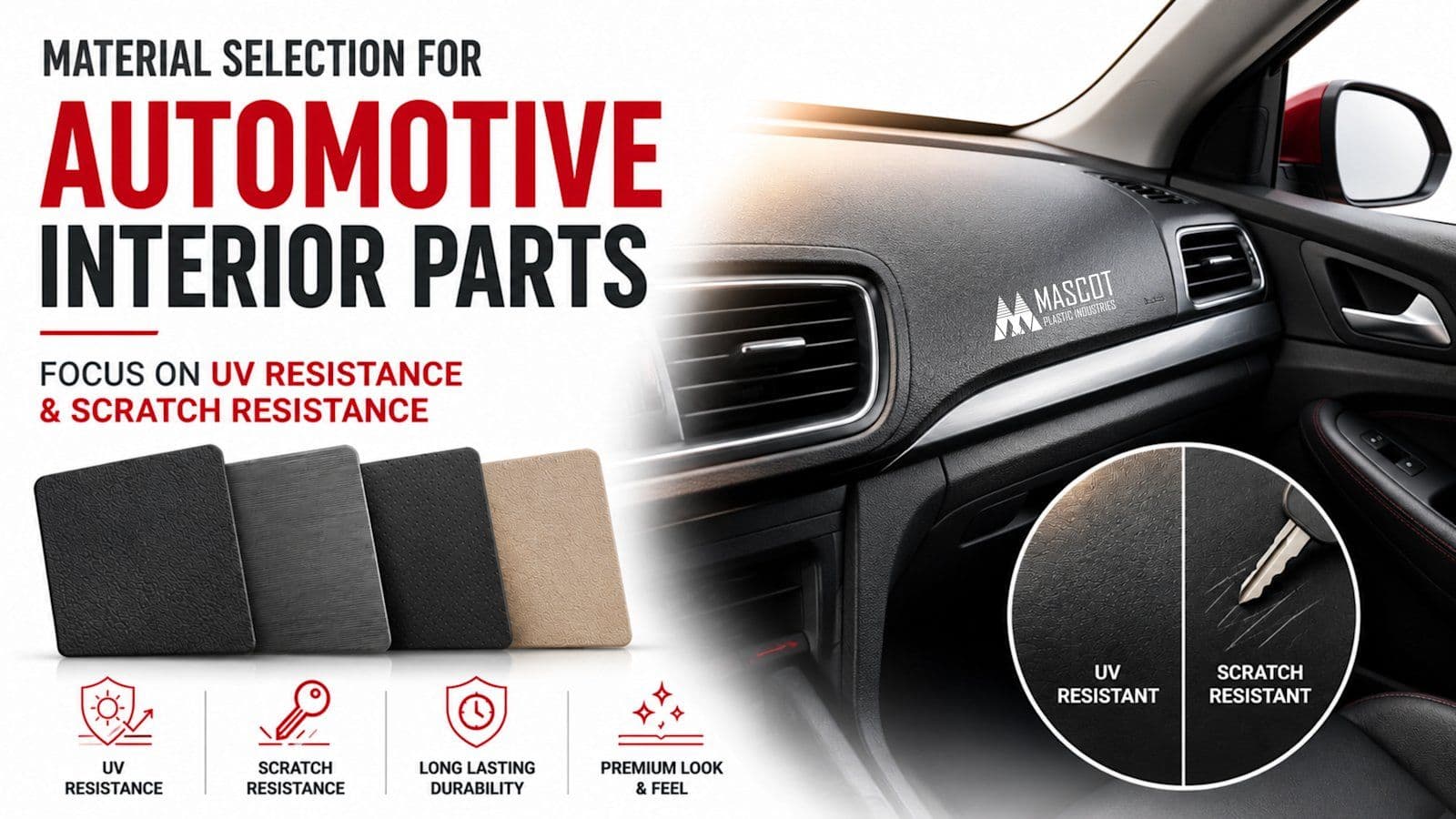
At Mascot Plastic Industries, material selection begins with understanding the component's operating environment. Whether manufacturing dashboard trims, center consoles, door panels, air vent assemblies, or control bezels, selecting plastics with excellent UV stability and scratch resistance is essential for delivering automotive-grade quality.
Modern vehicles contain over 150 to 250 plastic interior components, each designed with different performance requirements.
These include:
- Dashboard panels
- Door trims
- Center consoles
- Instrument clusters
- HVAC vents
- Glove boxes
- Cup holders
- Pillar trims
- Seat adjustment knobs
- Steering column covers
- Switch bezels
Although these components appear similar, they experience different levels of:
- Sunlight exposure
- Mechanical wear
- Heat
- Humidity
- Cleaning chemicals
- Passenger interaction
A material that performs well for an internal bracket may fail completely when used on a dashboard exposed to years of sunlight.
Many people assume that vehicle interiors are protected from sunlight because they are inside the cabin.
In reality, automotive glass blocks most UVB radiation but still allows a significant amount of UVA radiation to pass through. Over several years, this continuous exposure can degrade polymers.
Surface temperatures inside a parked vehicle may exceed:
- 80–90°C in hot climates
- Even higher on dark-colored dashboards
This combination of heat and UV radiation accelerates material aging.
Without proper UV stabilization, plastic components gradually deteriorate.
Common defects include:
Color Fading
Pigments lose stability over time, causing:
- Grey dashboards turning pale
- Black trims becoming brown
- Uneven discoloration
Color mismatch between adjacent parts significantly reduces perceived vehicle quality.
Surface Chalkiness
UV degradation breaks polymer chains near the surface.
The result is:
- White powdery appearance
- Rough texture
- Loss of gloss
This phenomenon is commonly called chalking.
Cracking
As polymers lose molecular integrity, they become brittle.
Small surface cracks eventually propagate into visible failures.
Loss of Mechanical Strength
UV exposure can reduce:
- Impact resistance
- Flexural strength
- Fatigue life
This becomes critical for clips and snap-fit features.
Consumers interact with automotive interiors thousands of times every year.
Common sources of scratches include:
- Fingernails
- Keys
- Coins
- Mobile phones
- Bags
- Child seats
- Cleaning brushes
- Dust particles during wiping
Even soft microfiber cloths can gradually produce visible micro-scratches on glossy plastics.
Premium vehicle manufacturers therefore demand plastics capable of maintaining their appearance throughout the vehicle's service life.
A scratched dashboard may still function perfectly, but customers associate visible wear with poor quality.
Scratch-resistant materials provide:
- Longer-lasting aesthetics
- Better resale value
- Reduced warranty claims
- Higher customer satisfaction
- Improved brand perception
In luxury vehicles, surface quality is often as important as structural performance.
Material selection depends on the specific component, expected loads, and desired finish.
Polypropylene (PP)
Polypropylene is one of the most widely used automotive plastics.
Advantages
- Lightweight
- Low cost
- Excellent chemical resistance
- Good fatigue performance
- Easy processing
Limitations
Standard PP has:
- Limited scratch resistance
- Moderate UV resistance
For exposed interior components, manufacturers typically use:
- UV-stabilized PP
- Mineral-filled PP
- Talc-filled PP
- Scratch-resistant PP compounds
Typical applications include:
- Door trims
- Pillar covers
- Storage compartments
- Interior panels
ABS (Acrylonitrile Butadiene Styrene)
ABS offers excellent surface finish and dimensional stability.
Advantages include:
- Smooth appearance
- High rigidity
- Easy painting
- Good impact strength
However, standard ABS has relatively poor UV resistance.
It is generally recommended for:
- Interior parts with limited sunlight exposure
- Painted components
- Decorative trim
PC/ABS Blends
One of the most popular premium automotive materials.
By combining Polycarbonate and ABS, manufacturers obtain:
- Excellent impact resistance
- High heat resistance
- Better dimensional stability
- Improved UV durability
- Superior appearance
Applications include:
- Instrument panels
- Console bezels
- HVAC controls
- Decorative components
ASA (Acrylonitrile Styrene Acrylate)
ASA is specifically engineered for outstanding weather resistance.
Compared with ABS, ASA offers:
- Exceptional UV stability
- Excellent color retention
- Better outdoor durability
Although commonly used in exterior components, ASA is also selected for high-sunlight interior applications.
Polycarbonate (PC)
Polycarbonate provides:
- High transparency
- Excellent toughness
- Superior heat resistance
Common applications include:
- Instrument cluster lenses
- Display covers
- Touch interfaces
Hard coatings are often applied to improve scratch resistance.
The base polymer is only part of the engineering solution.
Automotive compounds often contain specialized additives.
UV Stabilizers
These additives absorb or neutralize harmful UV radiation before it damages polymer chains.
Common technologies include:
- UV absorbers
- HALS (Hindered Amine Light Stabilizers)
- Antioxidants
Together they significantly extend service life.
Scratch-Resistant Additives
Compounds may include:
- Silicone modifiers
- Mineral reinforcement
- Surface lubricants
- Nano-scale fillers
These reduce visible scratching while maintaining surface appearance.
Glass or Mineral Fillers
Fillers improve:
- Dimensional stability
- Heat resistance
- Stiffness
- Reduced shrinkage
However, excessive filler loading may affect surface finish, requiring careful material optimization.
Scratch performance depends not only on the material but also on the texture applied to the mold.
Highly polished glossy surfaces reveal scratches much more easily.
Textured finishes:
- Hide minor scratches
- Reduce glare
- Improve tactile feel
- Enhance premium appearance
Automotive designers often use carefully engineered textures rather than mirror-polished finishes for frequently touched components.
Automotive manufacturers subject interior plastics to rigorous qualification testing before approval.
Common evaluations include:
UV Aging Tests
Components undergo prolonged exposure in accelerated weathering chambers to simulate years of sunlight.
Evaluations include:
- Color change
- Gloss retention
- Surface cracking
- Mechanical property retention
Scratch Resistance Testing
Specialized instruments apply controlled loads to determine:
- Scratch depth
- Surface damage
- Gloss loss
- Visibility of abrasion
Abrasion Testing
Repeated rubbing cycles simulate years of customer use.
Heat Aging
Samples are exposed to elevated temperatures for extended periods to verify dimensional stability and appearance.
Chemical Resistance
Interior plastics are tested against:
- Alcohol-based cleaners
- Sunscreen
- Hand lotion
- Coffee
- Soft drinks
- Automotive interior cleaners
As automotive manufacturers pursue lighter and more sustainable vehicles, material innovation continues to evolve.
Emerging solutions include:
- Recycled engineering plastics
- Bio-based polymer blends
- Low-VOC compounds for improved cabin air quality
- Lightweight mineral-filled materials
- Advanced nano-coatings for enhanced scratch resistance
These materials help manufacturers reduce vehicle weight while maintaining premium interior durability and meeting increasingly stringent environmental regulations.
Choosing the right polymer alone does not guarantee long-term performance.
Engineers must also consider:
- Wall thickness uniformity
- Gate location
- Mold temperature control
- Cooling system design
- Surface texture
- Pigment selection
- Processing conditions
- UV-stable color masterbatches
Proper mold design and optimized processing ensure that the selected material delivers its full performance potential.
At Mascot Plastic Industries, material selection is driven by application-specific engineering rather than cost alone. Our team evaluates each automotive interior component based on its exposure to sunlight, expected wear, aesthetic requirements, and structural demands before recommending the most suitable engineering polymer and additive package.
With advanced injection molding capabilities, scientific process control, and expertise in automotive-grade manufacturing, we produce interior plastic components that combine excellent surface quality, long-term UV stability, superior scratch resistance, and consistent dimensional accuracy. Our 60,000 sq. ft. manufacturing facility, Class 10,000 Clean Room, and 40+ advanced injection molding machines enable us to meet the demanding quality standards of automotive OEMs and Tier-1 suppliers.
Automotive interior plastics must do far more than simply fit inside a vehicle. They are expected to retain their color, texture, strength, and premium appearance throughout years of sunlight exposure and everyday use.
Achieving this level of durability begins with intelligent material selection. Engineering polymers such as UV-stabilized polypropylene, PC/ABS blends, ASA, and polycarbonate, combined with advanced additives, optimized mold design, and carefully controlled processing, provide the performance required for modern automotive interiors.
As vehicles become more sophisticated and consumer expectations continue to rise, selecting the right material is no longer just a design decision; it is a critical engineering strategy that directly influences product quality, customer satisfaction, and long-term reliability. At Mascot Plastic Industries, this philosophy guides every automotive component we manufacture, ensuring performance that lasts well beyond the production line.