
Glass-Filled Plastics Can Destroy Molds: Here's How Manufacturers Prevent It

Brought to you by
Mascot Plastic Industries
A precision plastic injection molding manufacturer and Malkar channel partner, specializing in engineering-grade polymers and contract manufacturing.
On This Page
As industries demand lighter, stronger, and more durable products, conventional plastics are increasingly being replaced by fiber-reinforced engineering polymers. By incorporating glass fibers or carbon fibers into a polymer matrix, manufacturers can significantly improve mechanical strength, stiffness, dimensional stability, and heat resistance without the weight penalty associated with metal components.
Today, highly filled materials such as Glass Fiber Reinforced Nylon (PA-GF), Polybutylene Terephthalate (PBT-GF), Polypropylene (PP-GF), Polycarbonate (PC-GF), and Carbon Fiber Reinforced composites are widely used in automotive, electrical, industrial, aerospace, medical, and consumer applications.
However, while these materials offer exceptional performance, they also introduce significant manufacturing challenges. Their abrasive nature, higher processing temperatures, increased viscosity, and complex flow behavior demand specialized mold design, robust tooling, optimized process control, and careful material handling.
At Mascot Plastic Industries, our engineering approach focuses on balancing material performance with manufacturability, enabling customers to leverage high-performance reinforced plastics while maintaining consistent quality and production efficiency.
Filled plastics contain additives that enhance specific material properties.
Common fillers include:
- Glass fibers
- Carbon fibers
- Mineral fillers
- Talc
- Calcium carbonate
- Mica
Among these, glass fibers and carbon fibers are widely used for structural applications because they dramatically improve mechanical performance.
Typical reinforcement levels include:
- 10% Glass Fiber
- 20% Glass Fiber
- 30% Glass Fiber
- 40% Glass Fiber
- 50% Glass Fiber
- Carbon Fiber Reinforced Grades
As filler content increases, the material becomes stronger, but also more difficult to process.
Fiber reinforcement transforms standard engineering plastics into structural materials capable of replacing metal in many applications.
Benefits include:
- Higher tensile strength
- Increased stiffness
- Better dimensional stability
- Reduced thermal expansion
- Improved heat resistance
- Better creep resistance
- Higher fatigue performance
- Weight reduction compared to metal components
These advantages make reinforced polymers ideal for demanding applications where lightweight design and mechanical performance are equally important.
Highly filled engineering plastics are used in:
Automotive
- Engine covers
- Air intake manifolds
- HVAC housings
- Structural brackets
- Battery enclosures
- Mirror supports
- Seat mechanisms
Electrical & Electronics
- Connector housings
- Circuit breaker components
- Electrical enclosures
- Switchgear parts
Industrial Equipment
- Pump housings
- Gear components
- Valve bodies
- Machine guards
Consumer Products
- Power tool housings
- Appliance components
- Sporting goods
- Precision mechanical assemblies
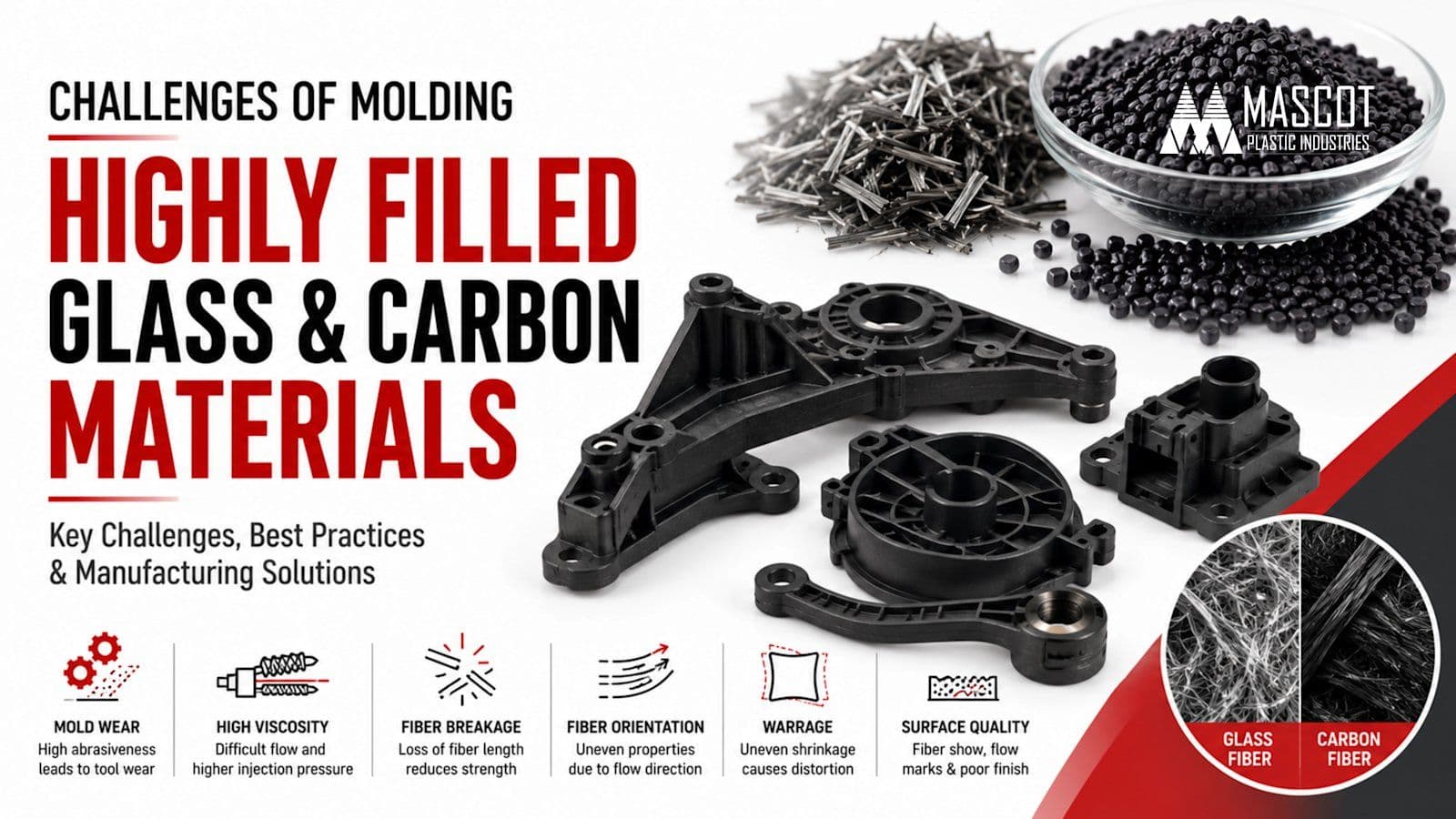
One of the first effects of adding glass or carbon fibers is a significant increase in melt viscosity.
Compared to unfilled plastics, reinforced materials:
- Flow less easily
- Require higher injection pressures
- Fill thin sections more slowly
- Become more sensitive to gate design
Poor flow can result in:
- Short shots
- Incomplete filling
- Flow hesitation
- Weld line defects
Proper part design and mold filling analysis become increasingly important as fiber loading increases.
Glass fibers are extremely abrasive.
During every injection cycle, thousands of microscopic glass fibers travel through runners, gates, and cavities at high speed.
Over time, they gradually erode steel surfaces.
Areas most affected include:
- Gates
- Runner systems
- Core pins
- Shut-off surfaces
- Vent areas
- Thin cavity features
Without suitable tooling materials, mold dimensions can change, affecting part quality and increasing maintenance costs.
Highly filled materials often require premium mold steels with superior wear resistance.
Common choices include:
- H13
- S7
- Hardened tool steels
- Powder metallurgy steels
Additional surface treatments such as:
- Nitriding
- PVD coatings
- DLC (Diamond-Like Carbon) coatings
can further extend mold life in abrasive molding environments.
Long fibers provide better mechanical performance.
However, excessive shear during processing can shorten the fibers.
Fiber breakage reduces:
- Tensile strength
- Impact resistance
- Stiffness
- Fatigue performance
Common causes include:
- High screw speed
- Small gate sizes
- Sharp runner transitions
- Excessive back pressure
- High injection shear
Maintaining fiber length requires careful process optimization.
Glass and carbon fibers do not distribute randomly.
Instead, they align with the direction of material flow.
This creates anisotropic properties, meaning the part behaves differently in different directions.
Consequences include:
- Uneven shrinkage
- Dimensional variation
- Reduced strength across the flow direction
- Warpage
Engineers must account for fiber orientation during mold design and structural analysis.
Although reinforced plastics reduce overall shrinkage, they may also create uneven shrinkage because of fiber orientation.
Different regions of a component may cool and contract differently.
The result can be:
- Twisting
- Bowing
- Distortion
- Assembly issues
Balanced gate placement and optimized cooling systems help minimize these effects.
Highly filled materials rarely produce the smooth cosmetic finish of unfilled polymers.
Common surface defects include:
Fiber Read-Through
Fibers become visible beneath the surface, creating an uneven appearance.
Flow Marks
High viscosity affects material flow, producing visible flow patterns.
Reduced Gloss
Glass fibers scatter light, reducing surface gloss.
Weld Line Visibility
Fiber reinforcement often makes weld lines more noticeable.
For visible automotive or consumer products, textured mold finishes or painting may be required to achieve the desired appearance.
Many reinforced engineering plastics require elevated processing temperatures.
Examples include:
- PA66 GF30
- PBT GF30
- PPS GF40
- PEEK CF30
Higher temperatures demand:
- Accurate temperature control
- Proper heater capacity
- Stable hot runner systems
- Heat-resistant tooling
Improper temperature management can degrade the polymer or compromise mechanical properties.
Several engineering plastics, particularly Nylon, are hygroscopic.
They absorb moisture from the environment.
If insufficiently dried before molding:
- Hydrolysis may occur
- Molecular weight decreases
- Mechanical strength is reduced
- Surface defects appear
Material drying is therefore a critical step in processing reinforced engineering plastics.
Due to increased viscosity, reinforced materials often require:
- Higher injection pressure
- Higher clamp force
- More robust machine components
Insufficient pressure can result in incomplete filling, while excessive pressure may increase flash and mold wear.
Selecting the appropriate molding machine is essential for consistent production.
The abrasive nature of glass and carbon fibers accelerates wear on tooling and processing equipment.
Routine maintenance becomes essential for:
- Gates
- Runners
- Vents
- Core pins
- Shut-offs
- Screw and barrel assemblies
Preventive maintenance helps maintain dimensional accuracy and extend tool life.
Successful molding of highly filled materials begins with thoughtful mold design.
Key considerations include:
Larger Gates
Larger gates reduce shear and help preserve fiber length.
Balanced Runner Systems
Uniform material flow minimizes pressure differences and improves filling consistency.
Efficient Cooling
Uniform cooling reduces differential shrinkage and minimizes warpage.
Adequate Venting
High-viscosity materials trap air more easily.
Proper venting prevents:
- Burn marks
- Short shots
- Gas entrapment
Robust Ejection Systems
Reinforced plastics are generally stiffer and may require higher ejection forces.
Well-designed ejector systems prevent part damage during demolding.
Consistent quality depends on proper material preparation.
Recommended practices include:
- Dry hygroscopic materials to supplier specifications.
- Store materials in moisture-controlled environments.
- Use contamination-free conveying systems.
- Monitor melt temperature continuously.
- Avoid excessive residence time in the barrel.
- Optimize screw speed and back pressure to minimize fiber breakage.
Careful handling preserves both polymer integrity and reinforcement performance.
Modern Computer-Aided Engineering (CAE) tools help engineers predict processing challenges before mold manufacturing begins.
Simulation can evaluate:
- Melt flow behavior
- Fiber orientation
- Pressure distribution
- Weld line formation
- Air traps
- Cooling efficiency
- Warpage
- Shrinkage
By identifying potential issues early, manufacturers can reduce development time, lower tooling modifications, and improve first-pass success.
The use of reinforced engineering plastics contributes to lightweight product design, helping reduce energy consumption in applications such as electric vehicles and industrial equipment.
At the same time, manufacturers are increasingly exploring:
- Recycled glass fiber-reinforced materials
- Bio-based engineering polymers
- Improved recycling technologies for fiber-filled plastics
- Optimized processing methods to reduce material waste
Balancing performance with sustainability is becoming an important consideration in modern manufacturing.
At Mascot Plastic Industries, processing highly filled glass fiber and carbon fiber materials requires an integrated engineering approach that combines appropriate material selection, scientific mold design, precision process control, and preventive tool maintenance. Every project is evaluated for fiber content, mechanical requirements, dimensional tolerances, and production volume to ensure reliable and repeatable manufacturing.
Supported by our 60,000 sq. ft. manufacturing facility, 40+ advanced injection molding machines, Class 10,000 Clean Room, and experienced engineering team, we manufacture precision reinforced plastic components that meet demanding performance requirements across automotive, industrial, electrical, and consumer applications.
Glass fiber- and carbon fiber-reinforced plastics have transformed modern manufacturing by enabling lightweight components with exceptional strength, stiffness, and dimensional stability. However, these performance gains come with increased complexity during injection molding.
Higher viscosity, mold wear, fiber orientation, warpage, moisture sensitivity, and demanding processing conditions require careful attention to material selection, mold design, machine capability, and process optimization.
By understanding these challenges and applying sound engineering principles, manufacturers can fully realize the benefits of reinforced plastics while maintaining consistent quality, long tool life, and efficient production. At Mascot Plastic Industries, this comprehensive approach allows us to produce high-performance molded components that meet the stringent requirements of today's most demanding industries.